
Delta · 0.5–4 Hz
- Sleep architectureA night, stage by stage
- Body clocksWhat a working week disrupts
- RecoveryStrategies the evidence supports
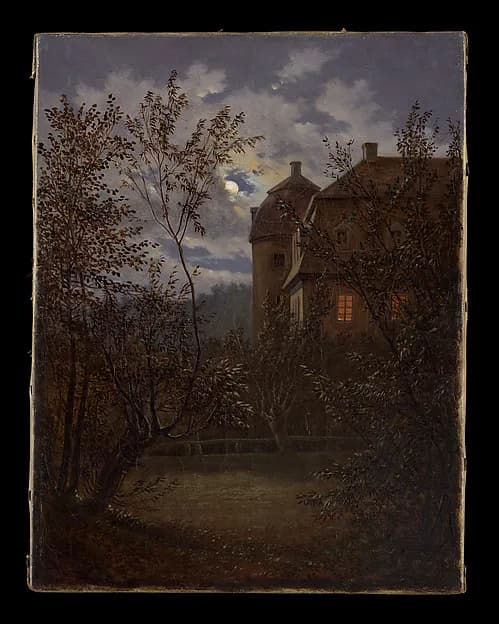
Schloss Milkel in Moonlight, Carl Gustav Carus, ca. 1833–35The Met, CC0
- Learn
- Practise
- Keep
Sleep & recovery workshop
Sleep Science
Recovery is part of the job.
Every other workshop we teach depends on this one. Sleep Science covers what happens during a night of sleep, what a body clock needs from a working week and which rest strategies the evidence supports, shaped around your shifts, time zones and deadlines.
Faster, smallerSlower, larger






















Who it is for
For teams running on less sleep than the work needs.
Night shifts, early markets, late calls across time zones, or simply a culture of answering after hours. If recovery has become the thing people give up first, this is the session to start with.
- Teams working shifts or across time zones
- Leaders who want a recovery norm, not a wellness poster
- Workplaces where tiredness shows in errors and short tempers
Delta · 0.5–4 Hz
Sleep runs in stages
and each stage does different work.
A night cycles through light sleep, deep slow-wave sleep and REM several times, and each stage does different work. The session follows that sequence and shows where working life interrupts it.
- AwakeFalling asleep, brief wakings
- REMDreaming, memory integration
- Light sleepStages N1 and N2
- Deep sleepStage N3, delta waves
Deep sleep is concentrated in the first half of the night and REM periods lengthen toward morning. A night cycles through these stages four or five times, which is why a late finish and an early start cut into different stages.
The evidence
Open a finding to read what was measured, where it stops and where it was published.
Seven hours is the adult floor
Watson NF et al. (2015)The American Academy of Sleep Medicine and the Sleep Research Society recommend that adults sleep seven or more hours a night on a regular basis to promote optimal health.
LimitA population recommendation. Individual need varies, and the statement sets no single upper limit.
Short sleep accumulates
Van Dongen HPA et al. (2003)Restricting sleep to four or six hours a night for fourteen days produced cumulative, dose-dependent deficits in attention and working memory, while participants' own sleepiness ratings understated the decline.
LimitA laboratory study of healthy adults under controlled restriction, not a measure of any team's output.
Sleep consolidates memory
Rasch B, Born J (2013)A review of the field concludes that sleep supports the consolidation of newly encoded memories, with slow-wave sleep and REM sleep contributing in different ways.
LimitA mechanism review. It explains why sleep matters for learning, not how much any one night will change recall.
SourceRasch B, Born J (2013), Physiological Reviews 93(2): 681–766
Body clocks and work schedules disagree
Roenneberg T et al. (2012)Across a large database of sleep timing, the mismatch between sleep on work days and on free days, termed social jetlag, was common and was associated with higher body mass index.
LimitCross-sectional and self-reported, so it shows association, not cause.
SourceRoenneberg T et al. (2012), Current Biology 22(10): 939–943
Delta waves dominate deep slow-wave sleep. The band names the workshop. A slow rhythm cannot be switched on at will, and nothing in the session diagnoses or treats a sleep disorder.
What the session covers
Four topics from the catalogue, each with an exercise on the team's own schedule.
- 01
Sleep architecture, stage by stage
In the roomMap a night on the hypnogram and locate where late finishes and early starts cut into it.
- 02
Circadian rhythms and body clocks at work
In the roomPlot the team's real working week against the body clock, with light, meals and caffeine timing on the same line.
- 03
What deep sleep does for memory and recovery
In the roomWork through what a shortened night costs the next day's attention, using the evidence rather than anecdote.
- 04
Evidence-based strategies for rest
In the roomChoose two changes per person that fit the schedule, and one team agreement about after-hours contact.
Formats
Sleep Science runs as a keynote on its own or shares a half or full day with another theme.
Keynote
One theme
A keynote brings the science, the stories and the practical tools to a conference stage or a town hall.
Half-day workshop
One or two themes
A half-day makes time to practise, and it is the format most teams start with.
Full-day training
Several themes
A full day works through exercises with your team's real cases on the table.
Every format runs both ways. Online sessions are designed for a remote audience, not compressed from the live version. Share your headcount and we will recommend a format. Compare the formats
What you keep
A shared vocabulary for sleep
The team can name sleep stages, body clocks and sleep debt accurately, which makes conversations about workload and recovery more precise.
Personal strategies that fit the schedule
Each person leaves with changes chosen for their own hours, not a generic list of sleep hygiene tips.
A team agreement about recovery
One or two norms about late messages, meeting times or shift handovers, agreed in the room with the evidence in view.
Pairs well with
Questions
About this workshop
The questions teams ask about Sleep Science before they book. Questions about workshops in general are answered on the catalogue page.
Is this a sleep workshop for shift workers?
It can be. The content is rebuilt around the schedule in front of us, so a night-shift operation gets a different session from a trading floor or a distributed team across time zones. Tell us the pattern and we shape the examples around it.
Will the session tell people to sleep eight hours?
No. We teach the consensus recommendation, seven or more hours for most adults, and the evidence behind it, then work on what is realistic inside your schedule. A number nobody can hit is not a strategy.
Does the workshop diagnose or treat sleep problems?
No. It is educational. Where a topic such as insomnia or suspected sleep apnoea comes up, we explain what it is and signpost professional support rather than offering treatment.
How long is the Sleep Science session?
It runs as a keynote, a half-day workshop, or as part of a full-day training combined with another theme. Half-days leave time to practise, and most teams start there.
Your next step
Bring Sleep Science
to your team.
Enquire about this workshop Tell us about your team, the format and the date you have in mind. The form opens with this workshop already named.